Parliamentary Select Committee hears from experts at University evidence session
Posted 23 March

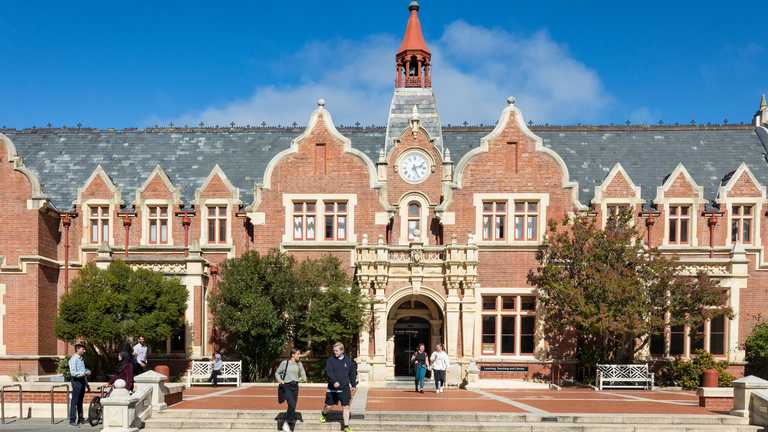
A Parliamentary Select Committee has visited 缅北禁地 as part of its investigations into animal and plant health and the future of farming.
The Environment, Food and Rural Affairs Committee held a formal evidence session as part of its visit, where it quizzed veterinary experts, including the Head of the (HKVS) Professor Matt Jones, on a range of issues.
The evidence will help inform two of the committee’s investigations, and the session it was presented in is part of formal Commons proceedings - despite, unusually, being held away from the Parliamentary estate.
Appearing alongside Professor Jones were the President of the Royal College of Veterinary Surgeons, Professor Tim Parkin; the Dean of the SRUC Veterinary School, Professor Caroline Argo; and the President of the British Veterinary Association, Dr Rob Williams.
The two-hour session covered a wide range of topics, including how the next generation of vets could be prepared for the demands of the profession.

Professor Jones gave an overview of the School’s innovative approach to workplace performance and wellbeing, and the importance of acknowledging the inherently stressful nature of the veterinary profession.
The approach includes incorporating psychological skills into the whole curriculum in the same way as professional skills such as communication and clinical reasoning. He added: “We will equip students and graduates with those skills, as we have done with clinical skills and knowledge for years.
“We can set them up for more successful, sustainable careers with those psychological skills and by looking at the environments within which we educate, so taking the focus off the individual and thinking about the organisational culture.”
This was echoed by Dr Williams, who added: “I welcome the approach that Harper and Keele has taken, including this element of understanding psychology and giving people the psychological tools to adapt and to thrive within the clinical setting, recognising that it is stressful—that it is normal for a clinical setting to be stressful because everything is high stakes; there is very little low stakes activity. I think Harper and Keele should be congratulated publicly for that.”
Professor Jones also talked about how the School had integrated the Animal Health and Welfare Pathway into its teaching – and the opportunities it presents.
He added: “It has so much upside to it. It is farm vets doing the kind of work they want to be doing in terms of on-farm advisory work and herd health work, and taking a proactive perspective to improve welfare outcomes as well as productivity.
"Those are opportunities for new graduates in particular and senior undergraduate vet students.
“We have a particular link through Jonathan Statham, who chairs the Animal Health and Welfare Board. That work is fed into our undergraduate curriculum starting in year one. It is a really nice feedback loop of driving positive, proactive engagement with industry for good outcomes.”
The Committee was watched by a public gallery including staff and students from across the University, including those on allied veterinary professional courses teaching Veterinary Nursing and Physiotherapy.
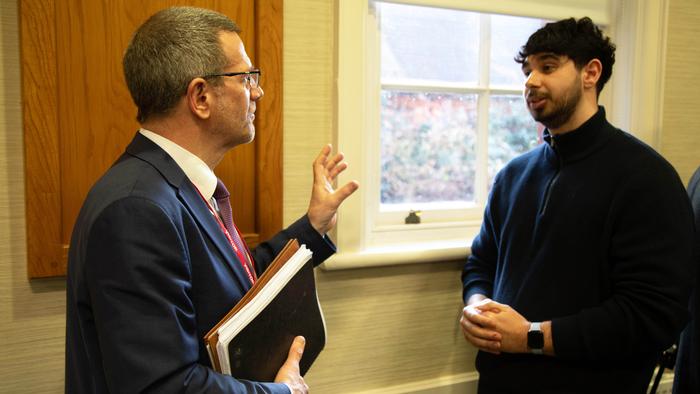
Committee members spoke with these students after the session – and met with more University employees and students the following day, to hold a roundtable discussion on skills and training needs within the agri-food and veterinary sectors.
This week, we visited to learn more about their cutting edge agritech research and speak to students about the future of the farming workforce.
— EFRA Committee (@CommonsEFRA)
As part of their wider visit, the Committee were also given a tour of the Harper Adams campus and estate.
This included a visit to the University’s vineyard, where they heard more about how the facility is being used to develop education and training around viticulture – the production of wine – and about how the University’s first wines from the site had been developed.
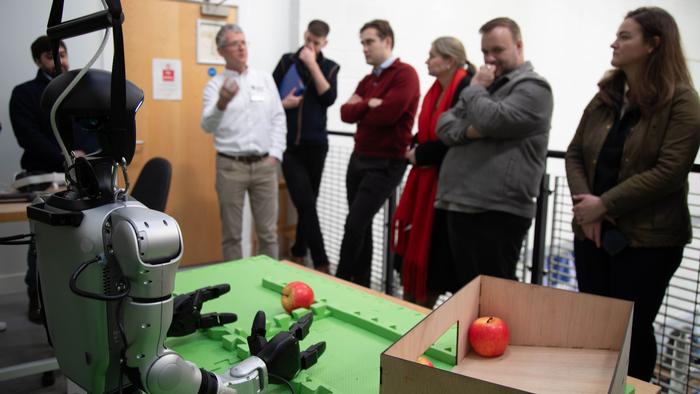
They also toured its Engineering facilities, hearing more about its groundbreaking work with robotics, automation, and simulation and seeing some of this research in action, and visited its award-winning Future Farm.
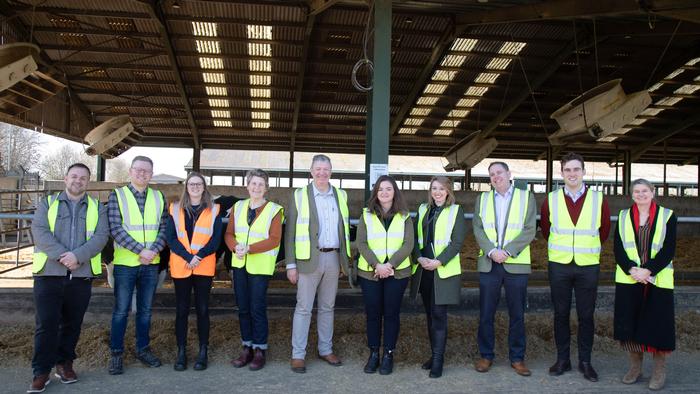
Here, they heard more about how the farm works to meet three separate but interlocked functions, operating as a commercial farm, a teaching facility and a research centre at the same time – and about how it is being used to help drive forward sustainable agriculture as the sector moves towards Net Zero.
Speaking after the visit, Harper Adams Vice-Chancellor Professor Ken Sloan – who gave evidence to the Committee during a previous visit to the University in 2024 – said: “It was a pleasure to welcome the Committee back to Harper Adams.
“They spoke to a range of key experts, including my colleague at the Harper & Keele Vet School, Professor Matt Jones, during the formal session - but it was also great to allow them a chance to speak more informally to our students and staff and to tour our facilities.
“These discussions will help to inform their future work – and to deepen their understanding of how we, as a specialist institution, are using science and technology to shape the future of the industries we serve.”
Most popular
-
 Her Royal Highness The Princess Royal to formally launch 缅北禁地's 125th anniversary celebrations
2 September -
 Watch: Students join 125 years of pioneers at 2026 Graduation ceremonies
16 September -
 Expanded clearing places designed to meet industry challenges
17 August 2022 -
 缅北禁地 launches free and immediate mental health and wellness support for students
18 September - Passion for farming secures scholar Cumbrian Agricultural Student of the Year award
23 September -
 First Honorary Degrees and Fellowships to be bestowed as 缅北禁地 marks 125th year
10 September